
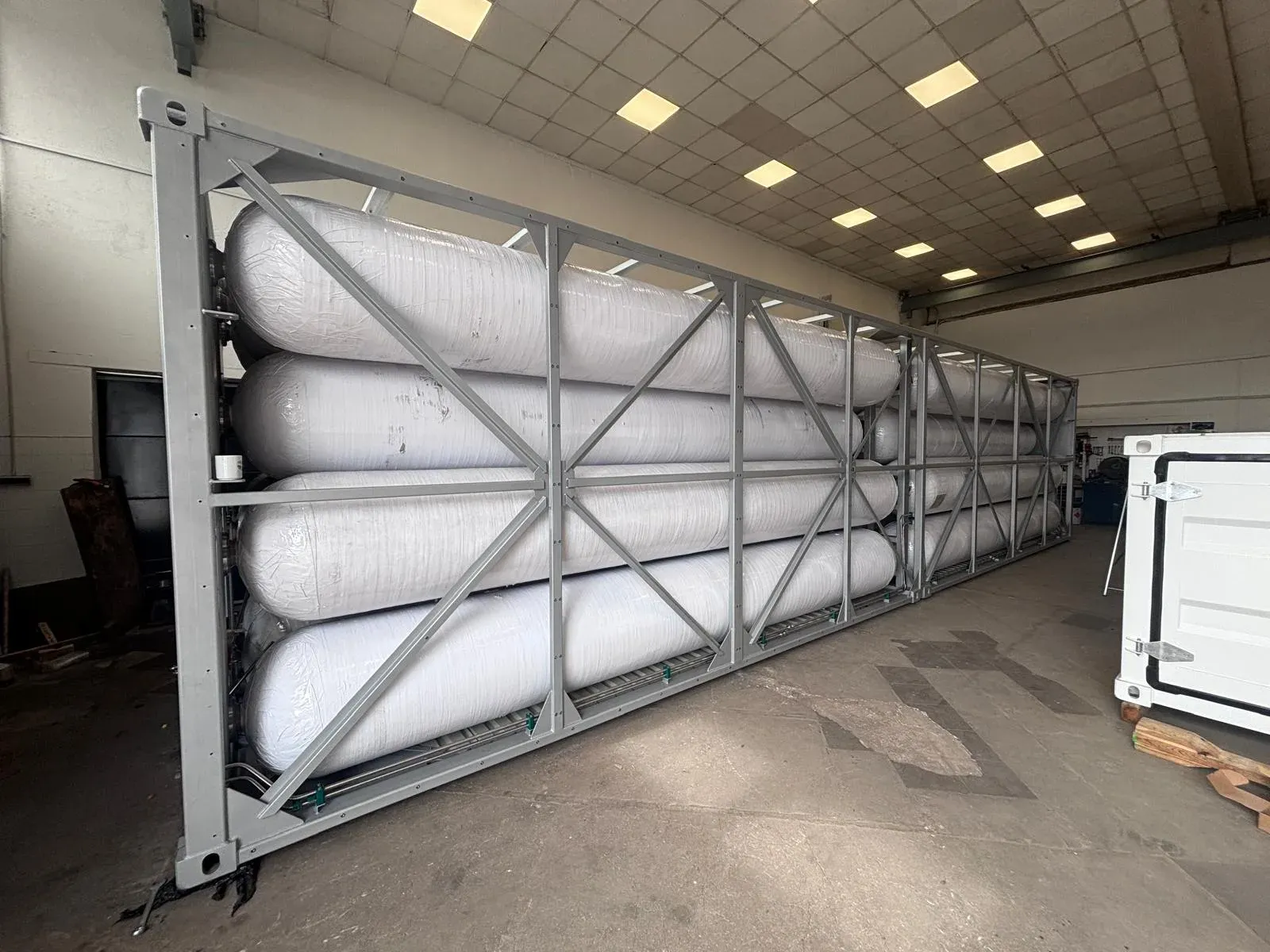
It is the first question every biogas plant asks and the hardest one to get a straight answer to. Brochures quote water capacity in litres, which tells you nothing about how much gas you will actually deliver. Some suppliers quote Nm³ at conditions they do not state. Others quote kilograms without saying what the gas composition was.
Here are the real figures, calculated with a reference-quality real-gas equation of state rather than the ideal gas law — because at 250 bar the ideal gas law overstates capacity by about 19%.
The basis
All figures below assume biomethane at 97% CH₄, 1.5% CO₂, 1.5% N₂ — a typical membrane or amine upgrading output. Nm³ are referenced to 0 °C and 1.01325 bar.
| Property | Value |
|---|---|
| Density, 0 °C / 1.01325 bar | 0.7443 kg/Nm³ |
| Density, 250 bar / 15 °C | 206.58 kg/m³ (Z = 0.8406) |
| Density, 250 bar / 35 °C | 184.73 kg/m³ |
| Lower heating value (LHV) | 9.666 kWh/Nm³ |
LHV and HHV — why the same gas has two energy figures
Burning methane produces carbon dioxide and water. That water leaves the burner as vapour, and it carries a substantial amount of latent heat with it. Whether you count that heat is the entire difference between the two figures you will see quoted:
- Lower heating value (LHV), also called net calorific value, counts only the heat you get with the water leaving as vapour. It is what an engine, a gas turbine or a conventional boiler actually delivers, because their exhaust is far too hot for the water to condense. For this composition: 9.666 kWh/Nm³.
- Higher heating value (HHV), also called gross calorific value, assumes the exhaust is cooled until that vapour condenses back to liquid, releasing its latent heat as well. For this composition: about 10.72 kWh/Nm³ — roughly 11% higher.
Identical gas, identical molecules, identical container. The only difference is an accounting choice about the water.
This is also why a condensing boiler can be advertised at over 100% efficiency: it recovers part of that latent heat, so it delivers more than the LHV its rating was measured against. Nothing is being created — the extra was always in the fuel, just not in the LHV number.
Which one applies to you. European grid injection, energy trading and most offtake agreements in our markets are written on LHV, so that is what we quote throughout this article. North American gas trading conventionally uses HHV, quoted in BTU or therms, which is a common source of confusion in cross-border projects.
The practical consequence: if a supplier’s capacity figure looks about a tenth better than ours, check which basis they used before concluding their container is bigger. It usually is not.
That compressibility factor of 0.8406 is the whole point. A cylinder at 250 bar holds 16% less gas than the ideal gas law predicts — which is the same statement as the 19% above, seen from the other end: 0.8406 is 16% below 1, and 1 divided by 0.8406 is 19% above it. Any capacity figure that does not account for it is wrong, and there are plenty of them in circulation.
Per cylinder
A single 1,666-litre Type 4 composite cylinder at 250 bar and 15 °C:
| Value | |
|---|---|
| Gas mass | 344.2 kg |
| Volume | 462.4 Nm³ |
| Energy content | 4.47 MWh |
Per container
These are the standard MEGC transport container configurations.
| Configuration | Cylinders | Water capacity | Mass | Volume | Energy |
|---|---|---|---|---|---|
| 20 ft HC | 11 × 1,666 L | 18,326 L | 3,786 kg | 5,086 Nm³ | 49.2 MWh |
| 40 ft STD | 18 × 1,666 L | 29,988 L | 6,196 kg | 8,323 Nm³ | 80.4 MWh |
| 40 ft HC | 22 × 1,666 L | 36,652 L | 7,572 kg | 10,173 Nm³ | 98.3 MWh |
All at 250 bar settled, 15 °C, gross of the residual that must stay in the cylinders — see below.
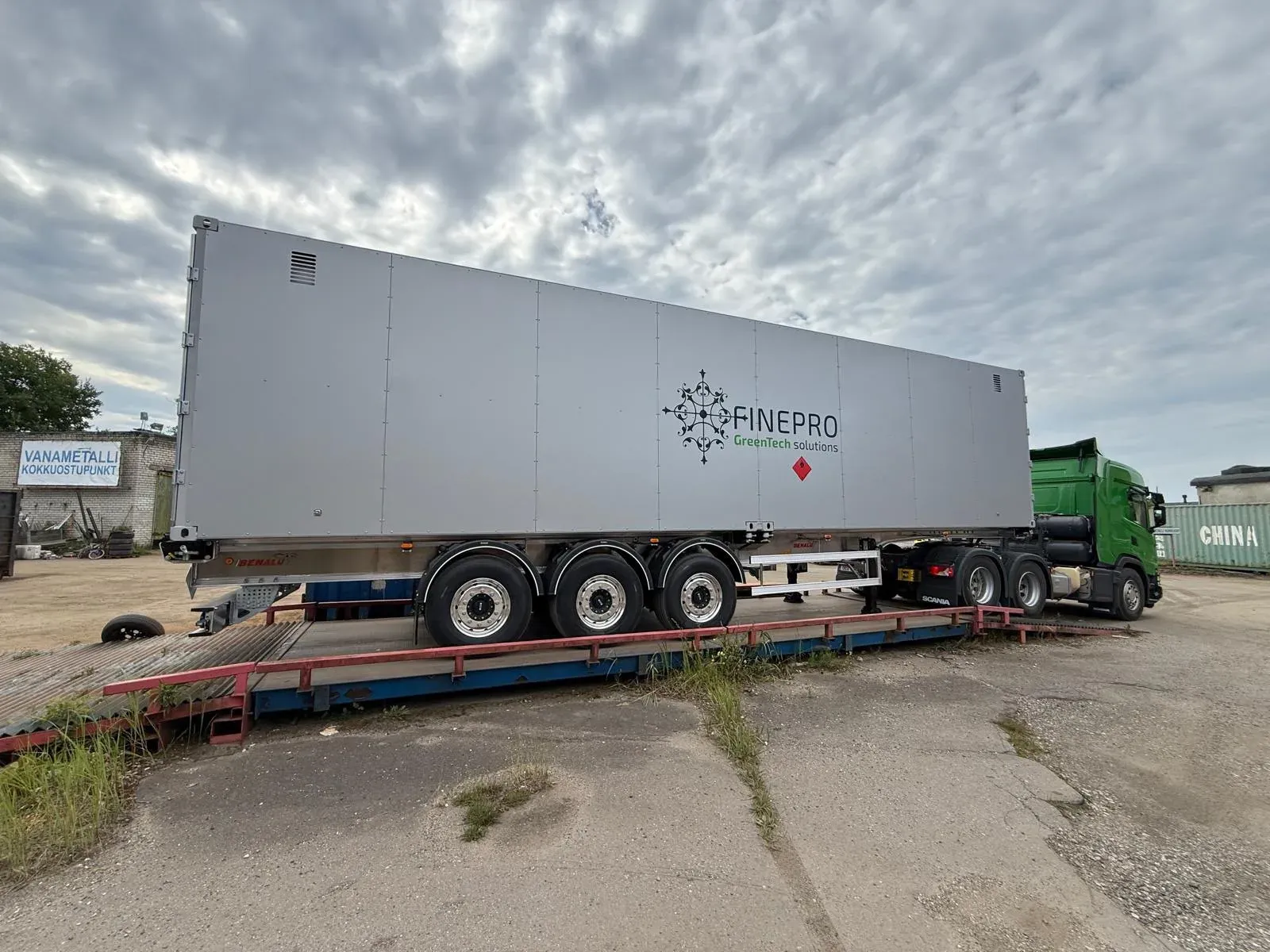
A note on the 22-cylinder 40 ft HC: at full fill the vehicle combination stays under 44 tonnes. That clears a 44-tonne permit regime, but it is still above a standard 40-tonne combination. Earlier versions of this frame ran heavier and left very little margin; the current construction is roughly 1,300 kg lighter, which is what creates it.
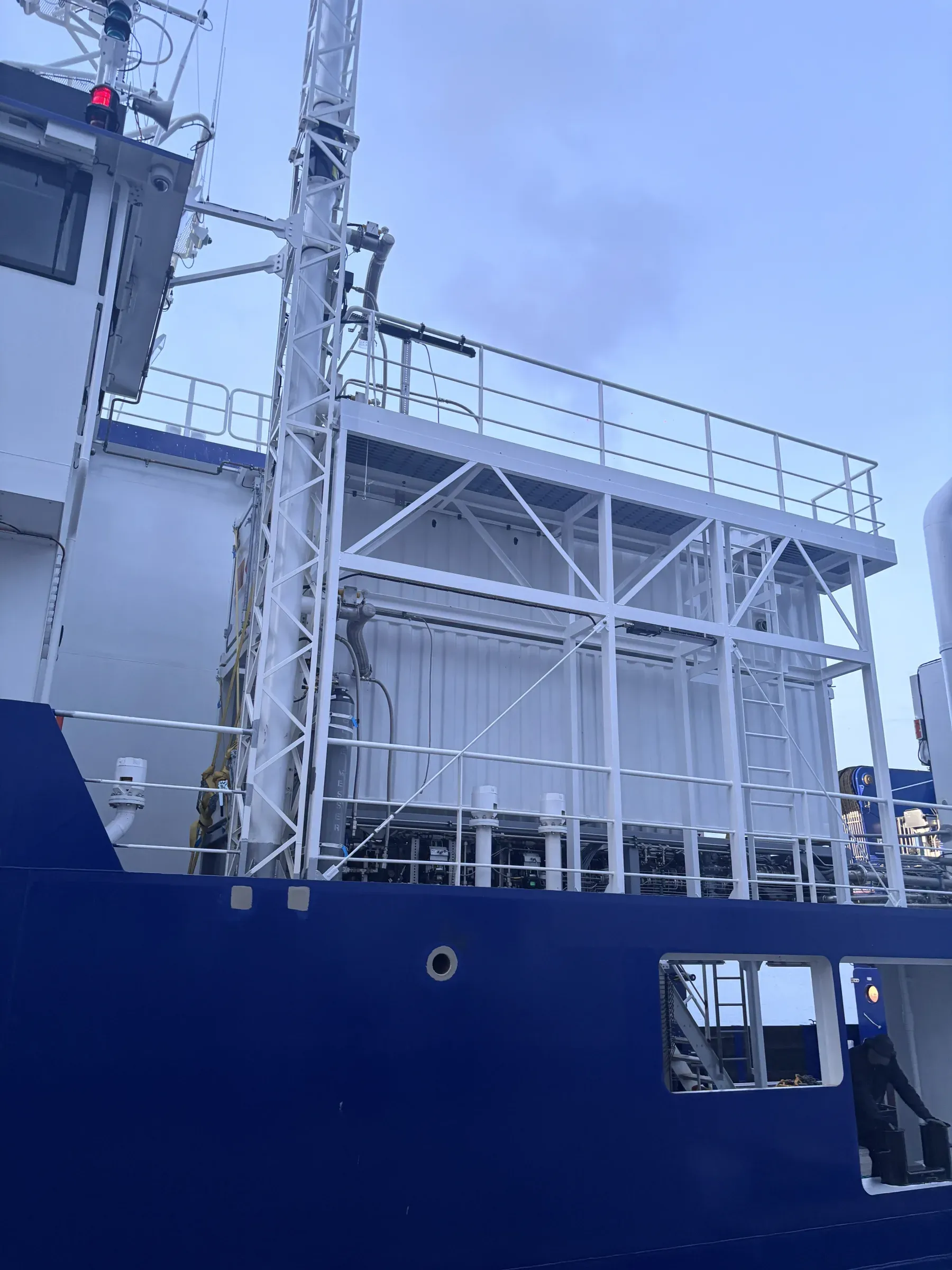
Containerised CNG equipment installed aboard a vessel. Payload still starts with the cylinder volume, pressure, gas composition and temperature inside the enclosure.
If you operate under a 40-tonne limit, this configuration is not for you — and a supplier who quotes it for standard road haulage without raising the point has not done the sum.
What you actually deliver: subtract the residual
You never empty a container, and you are not permitted to. A minimum residual pressure has to remain in the cylinders at the end of discharge, so that the system never falls to ambient and draws air and moisture back into a cylinder that is certified for dry gas.
The requirement is temperature-dependent:
| Ambient temperature | Minimum residual pressure |
|---|---|
| Above +1 °C | 10 bar |
| At or below +1 °C | 20 bar |
That residual is gas you paid to compress, carried the whole way, and take home again. It is not a rounding error, and in winter it doubles:
| Configuration | Loaded | Deliverable above +1 °C | Deliverable at or below +1 °C |
|---|---|---|---|
| 20 ft HC | 3,786 kg / 49.2 MWh | 3,656 kg / 47.5 MWh | 3,507 kg / 45.6 MWh |
| 40 ft STD | 6,196 kg / 80.4 MWh | 5,984 kg / 77.6 MWh | 5,739 kg / 74.5 MWh |
| 40 ft HC | 7,572 kg / 98.3 MWh | 7,312 kg / 94.9 MWh | 7,013 kg / 91.0 MWh |
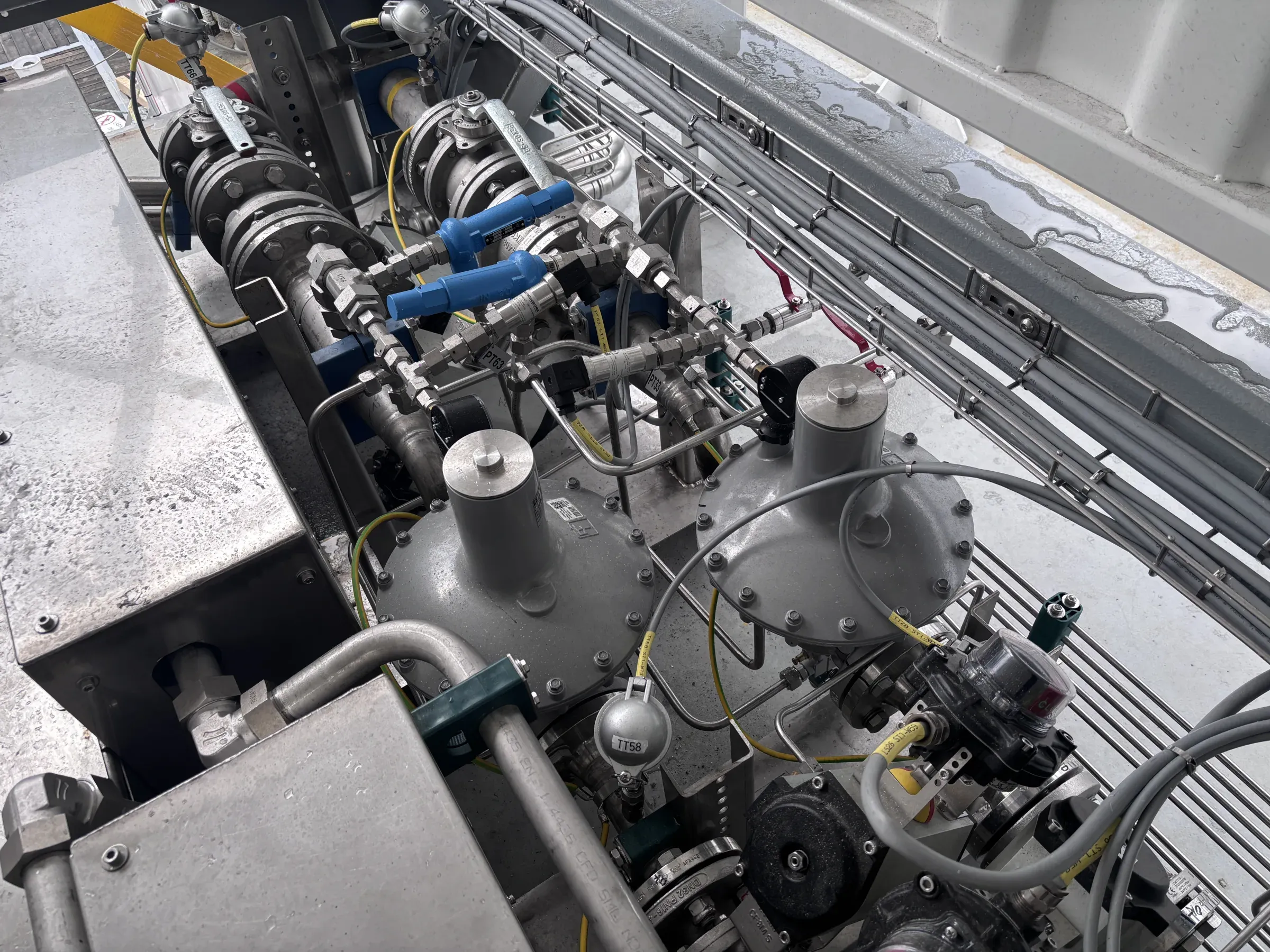
Pressure-reduction equipment at the receiving end. Gas retained in the container at minimum residual pressure is not deliverable product.
The proportion is the same for every configuration, because the residual scales with water capacity exactly as the payload does: 3.4% of the loaded mass above +1 °C, 7.4% at or below it.
Two things follow.
Quote deliverable quantity, not loaded quantity. If your offtake contract is written against the loaded figure, you are short on every single delivery, all winter, by four percent of the load. That is a dispute waiting to happen and it is entirely avoidable at the contract drafting stage.
Winter pulls in both directions. Cold gas is denser, so a container filled at 0 °C takes on more than the 15 °C figure in the table above — but the residual requirement also doubles, so more of it stays behind. The two effects partly cancel. Do not assume either one on its own; run both against your actual ambient range.
The temperature problem nobody mentions
This is where most real installations lose more capacity than they expect.
Filling to 250 bar with gas at 35 °C instead of 15 °C gives you 10.58% less gas. Same pressure on the gauge, same container, one tenth less product on the truck.
| Gas temperature at 250 bar | 20 ft HC (11 cyl) | 40 ft STD (18 cyl) |
|---|---|---|
| 15 °C | 3,786 kg / 49.2 MWh | 6,196 kg / 80.4 MWh |
| 35 °C | 3,385 kg / 44.0 MWh | 5,540 kg / 71.9 MWh |
That 10.58% figure is essentially composition-independent — it varies by less than 0.01 percentage points across the 95–100% CH₄ range — so it applies to your gas whatever your upgrading technology.
Compression heats gas. Without a chiller on the compressor discharge, summer filling at 30–40 °C is normal, not exceptional. Plants that size their logistics on the nameplate figure and then run a fleet in July find themselves one truck short.
Temperature compensation
The fix is to overfill slightly, so that the load settles to the same mass once it cools:
| Gas temperature | Fill pressure for equivalent mass |
|---|---|
| 15 °C | 250 bar |
| 35 °C | 292 bar |
| 40 °C | 303 bar |
| 50 °C | 324 bar |
| 65 °C | 355 bar |
A linear approximation of 250 + (T − 15) × 2.11 bar is accurate to ±0.3 bar between 15 and 50 °C.
Two hard constraints:
- The regulatory ceiling is 1.25 × working pressure — 312.5 bar for a 250 bar cylinder. Full compensation is therefore achievable at 35 °C. It is not achievable at 50 °C or above. Any table that shows 312 bar as the “equivalent” for 65 °C is confusing the regulatory cap with a physical equivalence.
- Your compressor has to be able to do it. A unit rated at 250 bar discharge cannot compensate at all. In practice a large share of existing stations cannot use this technique without a compressor upgrade — which is a legitimate reason to specify the larger container instead.
Contract in MWh, not kilograms
A closing point that has cost people real money.
If your offtake contract guarantees a delivered mass in kilograms, cleaner gas works against you. Raise methane content from 97% to 99% and the density falls — you deliver fewer kilograms but more energy. The customer receives a better product and the contract says you underperformed.
Specify capacity in MWh, or in Nm³ at a stated composition. It is the same number of molecules either way, and it removes an entire category of dispute.
Working out your own case
The figures above are for the 1,666 L cylinders used across our container range. If your configuration differs — different cylinder volume, count, working pressure or a gas that is not biomethane — the arithmetic changes and the compressibility factor changes with it.
Send us your plant output, your route and your fill conditions and we will return the payload figures for your case, computed on the same basis as this article. If you are still choosing between sizes, the 20 ft versus 40 ft comparison covers where the cost difference actually sits.
Related reading
Energy
ADR type approval for a MEGC: the complete document pack
Every document required to type-approve a Multi Element Gas Container and to operate it legally under ADR — the full checklist, and what to do if your supplier is missing one.
Energy
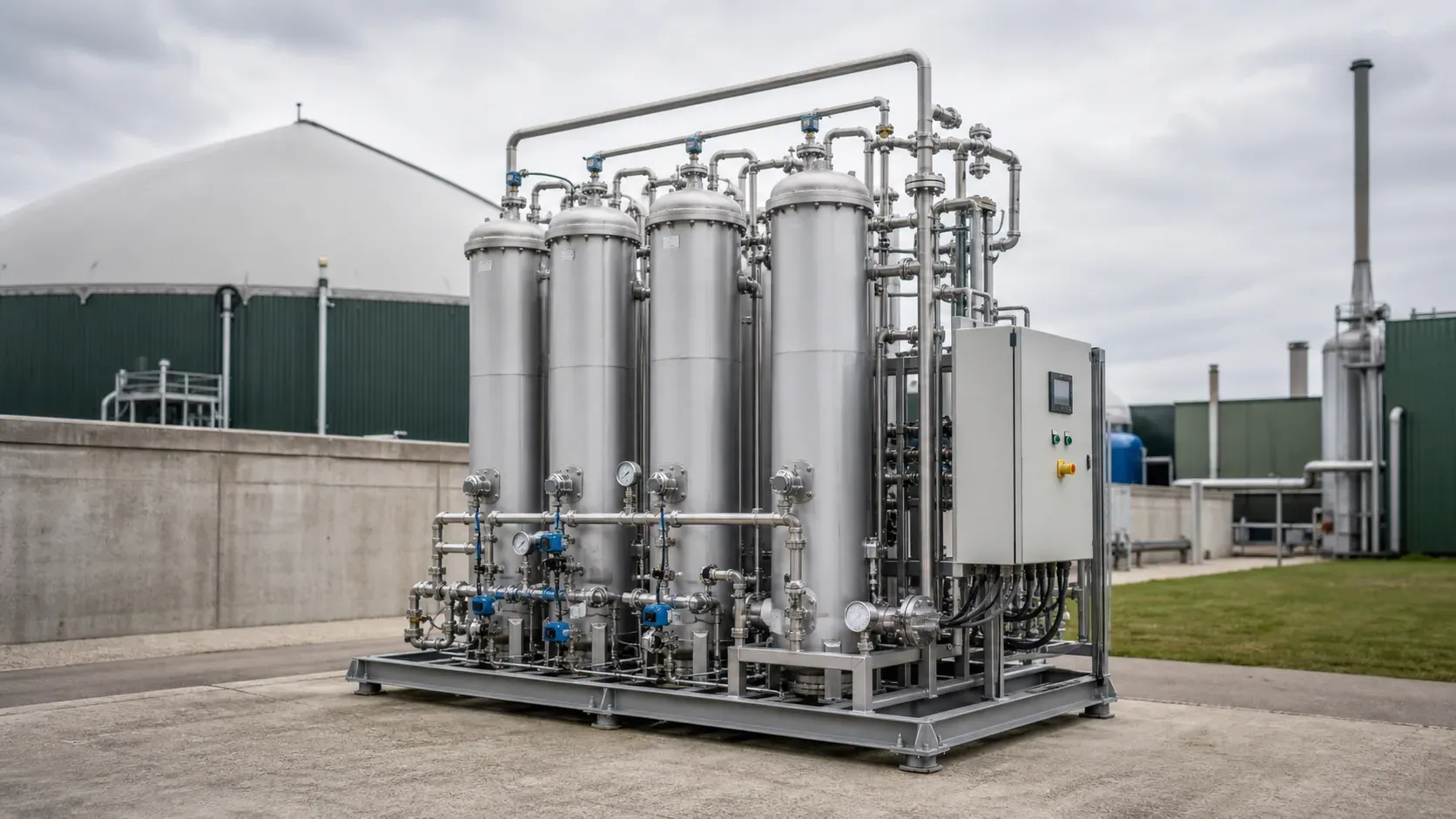
Pressure swing adsorption for biomethane production
How PSA upgrades raw biogas to pipeline-quality biomethane, including the science, operating economics, and cases where it is the right choice.
Energy
20 ft vs 40 ft MEGC: where the money actually is
The 40 ft MEGC is not cheaper per Nm³ to buy — cylinders are 75% of the cost and scale linearly. Its entire advantage is in the truck. Here is the break-even.
Talk to our engineers
From CNG and biomethane to hydrogen — we'll scope your project and reply within one working day.